



































 Listen
The ability of young people to develop healthy friendships with peers is critical to their emotional development and success in school. This author examines how the home and classroom environments affect friendship development, and points out specific factors readers can influence that help, or hinder, friendship development.
Of all the means to ensure happiness throughout the whole of life, by far the most important is the acquisition of friends. – Epicurus (Welty & Sharp, 1991, p. 65)
Positive human relationships are essential to healthy lives. Our relationships take on important roles – they serve to protect and help us, to give us comfort and joy, to sustain us in difficult times, and to validate our sense of worth and our concerns. We may be touched by many people in these ways, but our relationships with friends impact us immensely. We have written accounts of the meaning of friendship that go back thousands of years.
Cicero writes:
Now friendship possesses many splendid advantages, but of course the finest thing of all about it is that it sends a ray of hope into the future, and keeps our hearts from faltering or falling by the wayside. For the man who keeps his eye on a true friend keeps it, so to speak, on a model of himself: For this reason, friends are together when they are separated, they are rich when they are poor, strong when they are weak, and a thing even harder to explain – they live on after they have died, so great is the honor that follows them, so vivid the memory, so poignant the sorrow. (Welty & Sharp, 1991, p. 72)
Educators and parents, too, know the importance of friends for their students and children.1 Adolescents even tell us that friends are the best part of school (Goodlad, 1984). Making friends has been shown to be crucial to life adjustment (Duck, 1983; Hartup, 1992). Allan (1989), a sociologist, explains that friendships are important tangible resources for dealing with life’s demands, and that they “help sustain our social identity” (p. 50).
Implications for Students with Disabilities
Supportive peer relationships are thought to be particularly crucial to
the successful integration of students with disabilities into general
education settings (Forest & Pearpoint, 1992; Haring & Breen, 1992;
Stainback, Stainback, & Wilkinson, 1992). This may be, in part, related
to Asher et al.'s (1990) conclusion that “having at least one friend in
class may provide an important source of emotional support. In this
case, the child may still feel left out of the group as a whole, but may
not be experiencing as much emotional loneliness” (p. 263). However,
children and youth with learning and behavior problems are typically
unpopular and less accepted.2 – Their lack of social competence and their isolation lead to dismal
outcomes as adults, as we see from the National Longitudinal Transition
Study of Special Education Students (Wagner, D'Amico, Marder, &
Blackorby, 1992). Many children with disabilities are lacking the
friendship experiences that we as a society consider so important, and
they are suffering for the lack.
As parents and teachers, we try to help these students acquire more positive social behaviors and behave more appropriately, so that they will fit in better and be accepted by their peers. We have used social skills training and other behavior change technologies (Walker, Colvin, & Ramsey, 1995) to assist the child with behavior problems, assuming that he or she will be better positioned to be liked by peers and to form friendships after obtaining skills that provide some measure of social competence. That is, after we change the child's behavior to fit in, he or she will be likable.
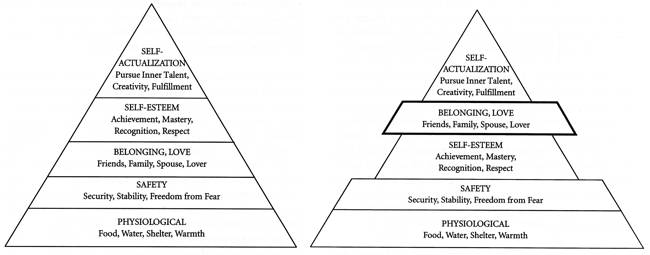
Kunc (1992) argues that these assumptions about
acceptance and belonging are in conflict with Maslow’s hierarchy of
human needs. If, as Maslow posits, a child's need to belong must be met
before the child will be concerned with learning and mastery of skills,
we should question the utility of assuming that students must learn new
skills before they can develop meaningful social relationships. Perhaps
it is not necessary, or even likely, for a child to become socially
competent in order for him or her to form beneficial peer relationships
and attain a sense of belonging. In fact, we know that many children who
have learning and behavior problems or who are generally rejected by
their peers do have one or more friends.3
Maslow's Hierarchy The Corruption of Maslow's Hierarchy
Friendship Is Not All Magic
Turnbull et al. (1995) believe that friendship has been overlooked as an
intervention for children. Kunc (1992) agrees that our schools have
various programs to meet children's needs at other levels (e.g., free
lunches to support physiological needs, health programs to support
safety needs, individualized assignments to meet self-esteem needs), but
that helping children belong and care for one another receives
relatively little attention. Friendship is traditionally approached as a
psychological phenomenon that occurs magically between individuals, and
so we take a “hands off” approach.
This may be changing, however, as teachers and researchers are looking for more substantive interpersonal interventions. More and more educators are recognizing the importance of teaching children to care for one another (Bosworth, 1995; Chaskin & Rauner, 1995; Lipsitz, 1995; Noddings, 1995). Kennedy and Shukla (1995) believe that we are entering a new stage of research, where attention will focus on developing more meaningful social relationships rather than developing skills. Meyer (1991) suggests that the focus of research should shift to “meaningful outcomes that endure and have broader impact upon the quality of life of the individual,” such as friendships (p. 644). If we consider friendship an important element in our lives, and if children with disabilities have trouble making friends, we need to look at the issues influencing friendship development.
Over the past several years, researchers have investigated how factors other than individuals' behaviors may account, in part, for the development, or lack of development, of friendships. These factors include:
Living arrangements (Barber & Hupp, 1993)
Opportunities to spend time together, materials, and activities (Buysse, 1993; Kemple & Hartle, 1997)
Proximity (Clark & Ayers, 1988)
Type of educational setting (Hamre-Nietupski, Hendrickson, Nietupski, & Sasso, 1993)
Emotional climate and arrangement of physical space (Kemple & Hartle, 1997)
Family influence (Parke & Bhavnagri, 1989; Searcy, 1996)
Access, encouragement, and continuity (Lutfiyya, 1991; Searcy & Meadows, 1994)
Allan (1989) argues that the availability of friends, what one does with these friends, and the use made of them are patterned as a consequence of the social structure of a child's environments. For example, children go to school each day and participate alongside chosen classmates in the activities designated by their respective teachers. They may or may not have after-school activities in which they participate. Likewise, children's home settings and the family’s degree of social interaction within the community are largely determined by their parents. Thus, most, if not all, of the child's environments are determined by adults, and the structure of these environments impacts the types of peer relationships formed, what friends are able to do together, and the depth of their interactions. Careful construction of these environments, therefore, can serve as a basis for intervention.
How to Create Friendship – Building
Environments
The adults who construct children's environments, primarily the
children's teachers and parents, must ask themselves how these
environments and the activities that take place in them are impacting
children's relationships. While there is still no conclusive research to
identify exactly which factors impact friendship development among youth
with learning and behavior problems, some helpful questions for their
teachers and family members to consider are as follows:
Does the environment (home or school) convey to
children that adults consider friendships important and obtainable?
Adults can model the importance of friends, address their importance
directly, and use friendship curriculum themes that emphasize the value
of friends. For instance, a history class might study the friendships
that existed among the signers of the Declaration of Independence, and
see how these relationships may have changed the world. Additionally,
the environment may convey overt or subtle messages that cause the child
to feel that he is, or is not, worthy and capable of making friends. If
parents and teachers never mention friends to a child who has
disabilities, yet they ask other children about their friends, this may
convey such a message.
Does the environment provide diversity in
friendship choices?
In contrast to the multitude of choices that
many of us enjoy when choosing our friends, some environments offer
narrower possibilities. For instance, settings in which there are few
children to know, restricted communicative abilities of peers, or a
concentration of children with designated characteristics may play a
part in the selection of friends. For example, what choices are offered
to the only two girls in a class with eight other boys, or to a youth
assigned to a school for juvenile offenders?
When a child is introduced into a new setting,
does he already know some of the children from other settings?
Relationships take time to develop. If a child has to begin anew each
time he is mainstreamed into a new class, for example, he may not have
sufficient time to develop an intimacy with those peers before his
placement changes again. In contrast, if the child joins a club that
classmates belong to, he may continue to deepen those relationships.
Does the environment give children ample
opportunity to talk, play, and get to know one another?
Children
with significant behavior problems are often taught in more structured
environments where interactions are more closely monitored and where
they have more interactions with adults than peers. Being in the same
room is not sufficient for friendship formation. Curriculum and
instructional strategies can be adapted to increase opportunities for
interaction. For instance, students can work cooperatively to produce a
dramatization of the story of Romeo and Juliet that offers more
opportunities to learn about one another than does the traditional
teacher lecture and student response format.
Do existing group dynamics between classmates or
neighborhood playmates exclude new members?
We all know how
damaging cliques can be to outsiders, but even generally positive group
dynamics can pose an obstacle to a new member. If play or work groups
are fairly stable when a new child is introduced, adults may need to
temporarily enforce new groupings to encourage the accommodation of the
new member.
Does adult presence limit or interfere with
typical peer interaction?
There is a fine balance between
supporting children in their interactions and getting in the way. Even
though their interactions may not be as “appropriate” without adults
involved, young people need time away from adults to reveal themselves
to peers.
What is the nature and function of the group
dynamics that are taking place while children with disabilities are
absent, either away from their class or away from their neighborhood
after-school play?
If the activities taking place while a child is
absent serve to bring classmates together, this might perpetuate his or
her isolation. For instance, if three of four neighborhood playmates
also play on the same winning softball team, one might anticipate that
the fourth boy will at least occasionally miss out on his friends' camaraderie. Likewise, if the teacher is reading a wonderful book aloud
to students each day, and that book is serving to create a bond of
excitement and fantasy among the class, does it alienate the two
children who instead go to the resource room at this time? No child can
be involved in everything, but adults can help by perceptive scheduling.
Does the environment allow children to be
together over a period of several years?
When a student has had
difficulty establishing relationships, his teachers and parents may need
to be especially sensitive to growing relationships. They may not appear
as typical friendships with displays of affection. For example, a
worthwhile interim relationship for some children, which can take some
time to develop, may involve toleration of unusual behaviors or an
awareness of each other’s needs. The richness of a friendship develops
with time.
Are children encouraged to interact, to be
positive in their interactions, and to get to know each other?
Giving children opportunities to interact, while important, may not be
sufficient to cause positive interactions. Children may need for their
teachers and parents to provide them with prompts or cues for
interaction. A child may be content to play alone on a playground full
of other children but may respond to his teacher’s encouragement to
share a ball with another child.
Are children encouraged to develop one-on-one
relationships in addition to a generally positive group culture?
Teachers learn about developing positive cultures in their classrooms,
but they may not extend their influence to developing one-on-one
relationships. This can be facilitated by pairing children repeatedly or
by suggesting after-school visits to the parents of two children who
appear to enjoy each other’s company.
Are the children provided with reasons or
expectations to interact with children they do not know well?
In
addition to the verbal prompts that may encourage children to interact,
environments can be structured to require such interactions. For
instance, when allowing children to work together on projects, students
can be given assignments that require the participation of all members.
Setting requirements for such interaction may be particularly helpful
for self-conscious adolescents or students who have defined their images
by their uninvolvement, because they cannot make an approach on their
own.
Are the activities structured for peer
interaction perceived as fun by the children, as shown in their laughter
and play?
Group activities can be fun or tedious, and too often
teachers seem to opt for closely controlled, tedious activities. By
paying better attention to what children enjoy, adults can help children
see another child at his best – when he or she is having fun. The shared
experiences of children at play may serve as bonds that develop into
friendship.
Conclusion
It is undeniable that many children's behaviors cause them to be
rejected by society at large. Their behaviors are often very
unacceptable to general society, and their problems on certain days may
seem overwhelming to the caring adults who work with them. Yet our
social and environmental structures serve to either enhance or to limit
the opportunities these children have to develop and maintain
relationships. If teachers and parents believe that friendships benefit
children and teach children important life skills, they must assume
responsibility for assessing the impact of the environments that they
create for children. These environments, thoughtfully constructed and
monitored, may serve as the basis for an intervention to help children
build and maintain friendships.
Notes
References
Allan, G. (1989). Friendship: Developing a sociological perspective. Boulder, CO: Westview Press.
Asher. S. R., Parkhurst. J. T., Hymel, S., & Williams, G. A. (1990). Peer rejection and loneliness in childhood. In S. R. Asher & J. D. Coie (Eds.), Peer rejection in childhood. Cambridge: Cambridge University Press.
Barber, D., & Hupp, S. C. (1993). A comparison of friendship patterns of individuals with developmental disabilities. Education and Training in Mental Retardation, 28(l), 13-22.
Bosworth, K. (1995). Caring for others and being cared for: Students talk caring in school. Phi Delta Kappan, 76(9), 68Cr693.
Buysse, V. (1993). Friendships of preschoolers with disabilities in community–based child care settings. Journal of Youth Intervention, 17, 4.
Chaskin. R. J., & Rauner, D. M. (1995). Youth and caring: An introduction. Phi Delta Kappan. 76(9), 667-674.
Clark, M. L., & Ayers, M. (1988). The role of reciprocity and proximity in junior high school friendships. Journal of Youth and Adolescence, 17, 403-411.
Duck, S. (1983). Friends for life: The psychology of close relationships. New York: St. Martin's Press.
Falvey, M. A., & Rosenberg, R. I. (1995). Developing and fostering friendships. In M. A. Falvey (Ed.), Inclusive and heterogeneous schooling: Assessment, curriculum, and instruction. Baltimore: Paul H. Brookes.
Forest, M., & Pearpoint, J. (1992). Families, friends, and circles. In J. Nisbet (Ed.), Natural supports in school, at work, and in the community for people with severe disabilities (pp. 65-86). Baltimore: Paul H. Brookes.
Goodlad, J. 1. (1984). A place called school: Prospects for the future. New York: McGraw–Hill.
Gresham, F. M. (1982). Misguided mainstreaming: The case for social skills training with handicapped children. Exceptional Children, 48(5), 422-433.
Guralnick, M. J., Connor, R. T., & Hammond, M. (1995). Parent perspectives of peer relationships and friendships in integrated and specialized programs. American Journal of Mental Retardation, 99(5), 457
Guralnick, M. J., & Groom, J. M. (1988). Friendships of preschool children in mainstreamed play groups. Developmental Psychology. 24, 595-604.
Hamre–Nietupski, S., Hendrickson, J. Nietupski, J., & Sasso, G. (1993). Perceptions of teachers of students with moderate, severe or profound disabilities on facilitating friendships with non–disabled peers. Education and Training in Mental Retardation, 28, 111-127.
Haring, T. G.. & Breen, C. G. (1992). A peer–mediated social network intervention to enhance the social integration of persons with moderate to severe disabilities. Journal of Applied Behavior Analysis, 21(2), 319-333.
Hartup, W. W. (1992). Having friends, making friends, and keeping friends: Relationships as educational contexts. Urbanu, IL: ERIC Clearinghouse on Elementary and Early Childhood Education.
Howes, C. (1988). Peer interaction of young children. Monographs of the Society for Research in Child Development, 53 (1 , Serial No. 217).
Kemple, K. M., & Hartle, L. (1997). Getting along: How teachers can support children's peer relationships. Early Childhood Education Journal, 24 (3) 139-146.
Kennedy, C. H., & Shukla, S. (1995). Social interaction research for people with autism as a set of past. current, and emerging propositions. Behavioral Disorders. 21 (1).
Kunc, N. (1992). The need to belong: Rediscovering Maslow’s hierarchy of needs. In R. A. Villa. J. S. Thousand, W. Stainback. & S. Stainback (Eds.), Restructuring for caring and effective education: An administrative guide to creating heterogeneous schools. Baltimore: Paul H. Brookes.
Kupersmidt, J. B., Patterson, C. J., & Griesler, P. C. (1988. July). Peer relations of children in special education. Paper presented at the NATO Advanced Study Institute on Social Competence in Developmental Perspective, Les Arcs, France.
Ladd, G. W. (1990). Having friends, keeping friends, making friends, and being liked by peers in the classroom: Predictors of children's early school adjustment. Child Development, 61, 1081-1100.
Lipsitz. J. (1995). Prologue: Why we should care about caring. Phi Delta Kappan. 76(9), 665-666.
Lutfiyya, Z. M. (1991). Personal relationships and social networks: Facilitating the participation of individuals with disabilities in community life. Syracuse, NY: Syracuse University Center on Human Policy.
Meyer. L. H. (1991). Advocacy, research, and typical practices: A call for the reduction of discrepancies between what is and what ought to be. and how to get there. In L. H. Meyer. C. A. Peck, & L. Brown (Eds.), Critical issues in the lives of people with severe disabilities. Baltimore: Paul H. Brookes.
Neel, R. S., Cheney, D.. Meadows. N. B., & Gelhae S. (1992). Interviewing, middle school students to determine problematic social tasks in school settings. Monograph in Behavioral Disorders: Severe Behavioral Disorders of Children and Youth, 15. Reston. VA: Council for Children with Behavior Disorders.
Noddings. N. (1995). Teaching themes of care. Phi Delta Kappan. 76 (9), 675-679.
Parke. R D., Bhavnagri, N. P. (1989). In D. Bell (Ed.), Children's social networks, and social supports. New York: Wiley & Sons.
Searcy, S. (1996). A child's social world: Parental perspectives. Beyond Behavior, 7 (1).
Searcy, S., & Meadows, N. B. (1994). The impact of social structures on friendship development for children with behavior disorders. Education and Treatment of Children, 17 (3).
Stainback, W., Stainback, S., & Wilkinson. A. (1992). Encouraging peer supports and friendships. Teaching Exceptional Children, 24 (2), 6-11.
Strully, J., & Strully, C. (1985). Friendship and our children. Journal of the Association for Persons with Severe Handicaps, 10(4), 224-227.
Turnbull, A. P., Turnbull R. H. III, Shank, M., & Leal, D. (1995). Exceptional lives: Special education in today’s schools. Englewood, NJ: Merrill.
Vaughn, S. R., McIntosh, R., Spencer–Rowe, J. (1991). Peer rejection is a stubborn thing: Increasing peer acceptance of rejected students with learning disabilities. Learning Disabilities Research & Practice, 6, 83-88.
Wagner, M., D–Amico, R., Marder, C., & Blackorby, J. (1992). What happens next – Trends in postschool outcomes of youth with disabilities. Menlo Park. CA: SRI International.
Walker, H. M., Colvin, G., & Ramsey, E. (1995). Antisocial behavior in school: Strategies and best practices. Pacific Grove, CA: Brookes/Cole.
Walker, H. M., & Rankin, R. (1983). Assessing the behavioral expectations and the demands of less restrictive settings. School Psychology Review, 12, 274 -284.
Welty, E., & Sharp, R. A. (1991). The Norton book of friendship. New York: W. W. Norton & Co.
This feature: Overton, S.S. (1997) The forgotten intervention: How to design environments that foster friendships. Reaching Today's Youth, 2(1). pp.6-10


