



































The complete set of 198 Hints are available in paperback from the CYC-Net Press store.
 Listen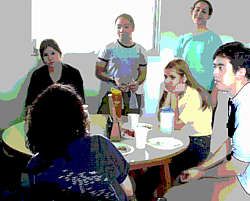
In any program for children, youth and families, our stock in trade is talk. We use to talk to engage, to cheer, to inform, to teach, give meaning, comfort, warn and reassure. And like anything else in our work, we have to find the time – or make the time – to do the talking.
What we talk about has always been a controversial issue in our field. For example, it has always been off-limits to proselytize young people into our beliefs, for example, political or religious. We remember that they belong to their own cultures and inevitably return to their own families and communities. Masud Hoghughi is helpful here when he reminds us that the purpose of treatment is to enhance that which is good, to reduce that which is harmful, and conserve that which is none of our business.
Yet we are not meant to be only "pals" to our clients. We do engage with them and enter their worlds, and as Redl suggested, we should not remain ‘friends without influence’. In our time spent with people we are concerned not only with clinical issues but also with informing, teaching, building, enabling, enriching ... and this certainly involves filling in the gaps of general knowledge, of ways of thinking about and dealing with the impact of the world at large.
For example, many people whose life is a struggle from day to day don’t get the opportunity to rise above their circumstances to get a long view of things. They become the victims of what Adler called "basic mistakes" and the "irrational beliefs" identified by Ellis in his system of rational emotive behaviour therapy. People draw conclusions from limited evidence, exaggerate out of all proportion the meaning of an event, see things simplistically as good or bad, and so on. With more information, people are less likely to draw faulty conclusions (this always happens to me, it’s our ‘family blood’, I am a failure, the only way to win is to cheat, I have to get a perfect score in this, I know I should be doing this, it’s no use trying ...).
In our practice today we make maximum use of the gaps in our program, times spent waiting for the next thing on the schedule, sitting-down times for a rest or a drink and a bite to eat – and in residential programs meal times and the period before bedtime – to discuss stuff. So what happened in the news today? Did you hear about that guy who ...? I wonder how we would have reacted? Do you think people always ...? What choices did she have? How did they achieve that?
Quite simply, we aim to send kids to bed with more to think about. By exposing people to a wider sample of events, they are less likely to be limited by the conclusions they draw from a few. More talk increases the grey area for people who only see things in black and white. Not to mention the colour.


