



































The complete set of 198 Hints are available in paperback from the CYC-Net Press store.
 Listen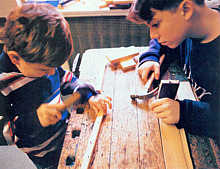
Some people have the idea that childhood ends on a certain day – poof!! – and that before that day children should do "children" things and not be expected to do "grown-up" things. Then, after that day, they should do grown-up things and drop the children things. This is similar to the idea that as children, people are only learning about how to live – and then on a certain day they can stop learning how to live and actually start living!
For most people, learning and growing is more incremental than that. Kids learn to tie their shoelaces at three and having achieved that they are admitted to the world-wide graduate community of competent shoe-laces tier-uppers, and they can then move on to become certificated tooth-brushers, master toast-makers and licensed lawn-mowers.
Put this progression to work in your program. As soon as a youngster can do something properly, he can teach others to do it. This means (a) that nine-year-old Charlie gets taught to use a hammer, and (b) twelve-year-old Mike gets a lot of status and acknowledgement as a hammer teacher. And the status thing is important. It is a strong reinforcer for Mike’s previous efforts (and hence his future efforts) as a learner, but it also changes his status from being a "taker" or "receiver" to being a "contributor" and a "giver-back."
This helps us to rethink our "human resource" problems in programs where the upbringing of a number of kids demands very intense curriculum. It certainly turns Mike into the best kind of role-model you could wish for. It also adds maturity to Mike’s on-going attitudes as a learner, teacher and liver of life. You can bet that when, in eight or nine years’ time, when he gets to teach Charlie to drive a car, both of them will take the responsibility pretty seriously.
Get your youngsters on this ladder of learning, making sure that they look both forwards and backwards


