



































 Listen
Management is about getting things done through other people. Managers strive to achieve organisational goals by arranging for others to perform whatever tasks may be necessary “not by performing themselves. Graphically, this can be represented as follows:
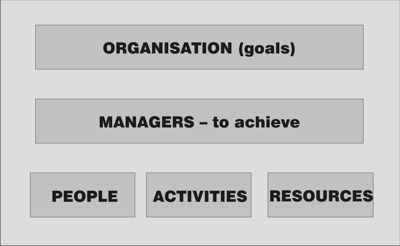
Managing is thus about people, activities, and meeting goals. Stoner defines management as: “... the process of planning, organising, leading and controlling the efforts of the organisation's members and of using all other organisational resources to achieve stated organisational goals” (1982). Our definition tells us that the manager’s task is to plan, organise, lead and monitor. These are not distinct/separate activities, but occur at the same time.
Planning
Plans are needed to give the organisation its goals and to set up
procedures for achieving them. Plans permit:
the organisation to obtain and commit resources required to achieve goals;
members of the organisation to carry on activities consistent with objectives and procedures;
the progress towards objectives to be monitored and measured.
The first task of the manager is to select goals and objectives for the organisation and to select programmes to achieve these goals and objectives.
Organising
Once the goals and objectives are established and the plans developed,
the manager must organise for them to be carried out successfully.
Organising involves co-ordination of the human and material resources of
the organisation. Systems and structures will need to be established to
obtain goals and objectives. This could involve arranging a meeting
system, for example, or schedules for child care workers.
Leading
After plans have been drawn up and the structure, systems and procedures
determined, the next step is to arrange for movement towards objectives.
This involves getting members of the organisation to perform in ways
that will help it to achieve the established objectives. It involves
directing and influencing those accountable to the manager.
Monitoring
Having planned, organised and provided leadership, the manager must
ensure that the actions of the personnel do, in fact, move towards the
organisation's goals. This is the monitoring function of the manager and
involves three elements:
establishing standards of performance;
measuring current performance and comparing against standards established;
taking action to correct performance which is not meeting standards (or rewarding performance which is exceeding standards).
Through the monitoring task the manager can keep the organisation on the right track and not let it deviate from agreed upon objectives. Given that these are the four main functions of the manager, what is expected of him/her?
Managers are expected to accomplish more than other employees because they have subordinates and resources to use in getting the job done.
Managers are expected to achieve goals and objectives with available resources and set priorities for use of resources.
Managers are expected to think analytically, creatively and globally. The manager’s task is to problem-solve. In order to do this problems must be broken down into component parts, be analysed and solutions decided upon.
Managers are expected to mediate. Because child care is a labour intensive field, conflicts will arise, either between staff or between staff and individual children. Because conflicts impinge on productivity and goal attainment, the mediating skills of the manager are vital. This requires skill, tact, understanding, persuasion and compromise.
Managers are expected to represent the organisation publicly. This calls for diplomacy, professionalism and being informed.
Managers are accountable. They are responsible for seeing that tasks are carried out in accordance with objectives. They are accountable for their own work and the work of others.
Managers are dependent on people. They work with and through other persons at various levels within the organisation. Managers are expected to be people-oriented.
Finally, managers need to make difficult decisions. Perhaps the most unenviable task of the manager is to make difficult decisions, particularly those impacting on staff members” and children's lives. Because of powers vested in the manager, difficult and sometimes unpopular decisions need to be made and carried out, for example, resource allocation or a staff dismissal. This is where the buck stops. How well an organisation does depends on how well the managers perform. Managers are thus vital links in achieving goals.
How is a manager’s performance evaluated?
A manager’s performance is measured by two yardsticks: efficiency and
effectiveness. Efficiency is doing things right, that is, on time with
minimum use of resources. Effectiveness is doing right things, that is,
the ability to choose appropriate objectives, selecting the correct
tasks to get done.
It is important to remember that efficiency does not compensate for lack of effectiveness. For example, in treating a child, it is no use having regular individual counselling sessions in a nice environment on time, etc., if individual counselling is not the appropriate treatment method and group work would actually be more effective and beneficial.
I would like to pick up on a few management concepts where managers often go wrong, and discuss them in turn. They are: time management; participation in organisation decision-making; decision-making styles; delegation; motivation.
Time management
In different roles, time is allocated differently. The manager’s time is
spent carrying out the four functions mentioned earlier. If any function
is neglected, this impacts on the other functions. For example, too
little time spent on planning asks for problems, as does no time
allocated for monitoring of activities. A balance is needed.
Participation in decision-making
Involve people in the decision-making process. This is what democracy is
all about. Everyone has something to contribute. I’m not saying that one
must consult on the “colour of the paper clips”, but policy and major
decisions should emanate from below. Encourage participation and sharing
of ideas. The manager must, however, retain the right to choose another
path.
Decision-making styles
Some problems come to managers, others they must locate themselves. No
manager can handle all the problems coming his/her way. It is important
to learn how to set priorities among problems and to give subordinates
responsibility.
When confronted by a problem the following should be asked: “Is the problem easy to deal with? Might the problem resolve itself? Is this my decision to make?”
Decisions can be referred up or down and can be made by the manager as follows:
he can solve the problem with no information;
he can hear information from individuals and then decide himself;
he can share the problem with a group of others and then decide by himself;
he can share the problem with the group and take a group decision which may be contrary to his own desire.
I would always advocate listening to others, sharing ideas but would reserve the right to make a decision.
Delegation
Delegation involves assigning to others formal authority and
responsibility for carrying out certain activities. This is often
necessary for the efficient functioning of an organisation. The manager
should delegate as much as possible but have a report-back system to
ensure that correct action was taken.
Motivation
A major part of the manager’s job is to motivate others. His ability to
motivate, influence, direct and communicate with subordinates will
determine his effectiveness. Motivation produces, channels and sustains
individual behaviour. In motivating people it helps if:
they feel important;
are part of decision-making;
have access to managers;
are listened to;
are recognised as valuable assets;
are informed.
Conclusion
The manager’s task is not an easy one. He/she is expected to perform, be
available and produce miracles from people who account to him and those
to whom he is accountable. Numerous people impact on and interact with
the manager each day. At the end of the day, however, it is the
efficiency and effectiveness of the manager which determines the
organisation's success.
Bibliography
Stoner, J.A.F. Management. Prentice-Hall International, Inc.
Englewood Cliffs, N.J. 1982.
This feature: Atmore, E. The role of the manager in child care work. In Biderman-Pam, M. and Gannon, B. (1989). Competent Care, Competent Kids. Claremont: National Association of Child Care Workers, pp. 14-18


