



































 Listen
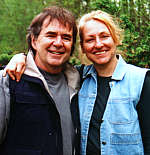
Thom and Sylviane in Montreal
In May I had the opportunity to spend some time in North America – three weeks in Canada and then one week in the USA. It was my first time away from South Africa since 1985 and so I flew from Cape Town to Montreal with some excitement. I had a week at home with Thom and Sylviane before a week of work and holiday in Nova Scotia. Thom Garfat is well known not only in Canada and the US but also to South African child care workers, having been a keynote speaker at two of the NACCW’s Biennial Conferences, and he and I are joint Editors of CYC-NET. Sylviane is herself a Child and Youth Care worker, doing very interesting work outside of the residential side of the field with youth and families in Montreal.

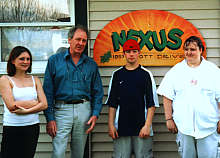
Top: With Carol Kelly and Mark Hill and below: with some of the kids at Nexus in Kentville
Thom and I flew to Halifax, Nova Scotia, on Sunday 14 May, and spent Monday driving through the breathtaking coastal and valley scenery en route to Kentville to visit the Nexus program. I was most interested by the way in which Mark Hill and his team at Nexus work with young people and their families out in the community, using the residential facility only when needed – perhaps only at times when the youth or family were in special difficulties, perhaps only over weekends, perhaps during the school week. Their “caseload" for example was double the number of youngsters actually in residence. My assignment here was to tell the team something of Child and Youth Care work in South Africa, and also to lead a discussion on various career and practice issues in work with young people.
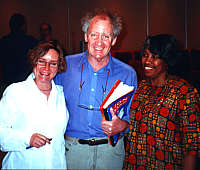
At the Halifax workshop with Karen Crossley of the local Association and Althea Tolliver of the Nova Scotia Home for Colored Children
Ethics
The next day, Wednesday, I had been invited to run a workshop in Halifax
for the Association for the Development of Children's Residential
Facilities (ADCRF) which has 125 staff members working in 6 facilities
for young people between the ages of 12 and 16 years old. Presently,
they run two group homes for females, two for males, one facility for
young people exiting or at risk of street prostitution and one crisis
assessment centre. The task was to address certain ethical aspects of
our profession and it was intended that we would do this mostly in small
group work. However a number of other organisations had asked whether
their staff might also attend, and in the end we spent a most
interesting day in the auditorium of the city’s IWK Children's Hospital.
Those attending had the opportunity to work in groups with a number of
real ethical issues while learning something of the world-wide
development of the Child and Youth Care profession. Those present agreed
with my suggestion to close the day’s work by reciting together the
public declaration which child care workers in South Africa make on the
occasion of their registration as professionals. Linda Wilson, the
ADCRF’s Director was returning to the auditorium from a meeting while we
were doing this, and she said it sounded as though we were all praying!
One outcome of this workshop was a renewed determination on the part of
many who were present to persevere with the building up of the
professional association in their area. The NSCYC website can be found
via a link at www.Together2000.net
College
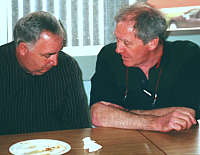
With Hugh McIntyre at the NSCC
We in South Africa have often looked with envy at the number of teaching and training opportunities available for Child and Youth Care workers in North America – literally dozens of universities and colleges which offer Child and Youth Care courses at various levels. So it was a great privilege for me to visit the course offered at the Nova Scotia Community College in Truro on the Thursday. This is a one-year program, and is the only training program for Child and Youth Care workers in Nova Scotia. The Course Co-ordinator, Hugh McIntyre, has been a member of CYC-NET for a long time (as are most of the students) so I continued to put faces to so many names which were already familiar to me.

Lunch with the students. At the left is Ernie Hilton, Supervisor of Sullivan House in Halifax, who came along for the food ... and of course for the meeting!
The Truro students were out on their practicums at the time, and had returned to the college specially for this event. After a mid-morning break, Thom and I ran a question-and-answer session for the students – and then I was to share in one of those uniquely Child and Youth Care “rites" which are to be seen all over the world: teachers and students sat down to a communal lunch in the course’s common room, something which few other faculties would plan with their students.
Cape Breton
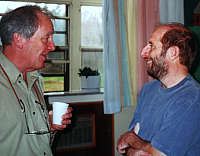
With Charlie Coleman of the Boys' and Girls' Residential Centres
On the Wednesday afternoon we drove to a most rugged and beautiful part of the world – carried over the water by a cable ferry – to Cape Breton Island at the north-eastern end of Nova Scotia. The principal town is called Sydney, formerly a centre of fishing and mining, both of which industries have fallen away, which is now seriously threatened by a devastated economy and unemployment. I had been asked to work with a particular agency in clarifying purposes and possibilities in the Boys' Residential Centre (in New Waterford) and the Girls' Residential Centre (in Sydney). Bobby O'Handley and Charlie Coleman were our friendly hosts. During the all-day workshop on Friday the group of Child and Youth Care workers, supervisors, agency seniors and government welfare officials worked on issues which many agencies around the world struggle with – agencies being clearer about the purposes (not just the reasons) for their referrals to residential programs and, at the same time, residential programs being clearer about what they do and what they have to offer in the continuum of services.
Once again we were to be dealing with issues concerning the professionalisation of Child and Youth Care – not just “working professionally" but being able to define our knowledge base, our practice skills and our way of being with the youngsters, their families, their communities and the social and government agencies who manage, fund and make policy for Child and Youth Care work.
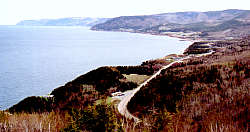
Left: A view on the Cabot Trail around the north coast of Cape Breton Island
My memory is of an afternoon in which we all became more aware of the richness and complexity of our work, the immense difficulty of prioritising developmental and behavioural tasks, and of our responsibility to be more articulate about (an more active in our advocacy for) what Child and Youth Care work does with troubled kids and families. The workshop reflected a stimulating level of discussion and commitment which characterised all that I saw of the field in Nova Scotia.
A free day allowed us time to end the Cape Breton visit on a high note, returning via the celebrated Cabot Trail, offering a truly spectacular variety of mountain and coastal views.
Minnesota
After another week in Montreal with Thom and Sylviane (a mix of talking
and cooking and sight-seeing and preparing for the coming week) I flew
to the Twin Cities of Minneapolis-St Paul where I was to present a
course on Working with Youth – Individual. (Two related courses
on Working with Groups and Working with Communities were also
to be included in the series).
Here I had the opportunity to reconnect with old friends and colleagues. My first hosts were Prof. Jerry Beker (who was a Keynote Speaker at the NACCW’s 1981 Conference in Johannesburg) and his wife Emily. Jerry was for many years Editor of Child and Youth Care Quarterly (later the Forum) and has been a major force in our field – in relation to academia and practice and to publishing and writing, and perhaps most of all through his encyclopaedic knowledge of “who’s who and who’s doing what" which shows itself in his capacity for linking and introducing people to each other across the world.
I spent an evening with South African colleague Leon Rodrigues and another with Prof. Mike Baizerman who is also well known to South African child and youth workers. My hosts while presenting the course were Youth Studies Course Co-ordinator Mary Burnison and her family.
The course
The students on the course came from a number of very different practice
fields – social work, residential work, community work, hospital work,
locked ward work, working with different client groups including at-risk
kids and families, justice adjudicated youth, addicted kids, etc. This
meant that course content had to be applicable to all of these
circumstances, and this made for a very interesting week for me. The
theme we followed was the tension between what others expected from us
(society, funders, the media, the courts, other professionals, our
managers, supervisors and team colleagues) – and how we ourselves judged
that we should be acting (in terms of our knowledge, experience, ethics,
assessments, resources, etc.) as we approached each new task in our
day-to-day practice with youth at risk. As we worked through problems
and scenarios, and balanced these against the realities of our work, it
was clear that child and youth workers have to be very sure about
themselves as they make critical judgement calls, moment by moment, in
the life-space of youth and families.
The class worked hard and we finished the course on the afternoon of Saturday June 3 – leaving me a couple of hours to get to the airport for my journey back to Cape Town. I made many new friends, saw wonderful things and learned a great deal. One of the pleasant surprises was meeting people whom I already knew through CYC-NET – virtually all of the people I have mentioned are members – and meeting new people who were working with – and often experiencing similar difficulty with – similar issues and problems that we face here in South Africa. My conclusion is that there are barren patches and nice tracts of green grass on both sides of the fence!
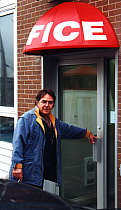
Thom pretends to be entering the headquarters of FICE – but it's just the (OF)FICE of the motel.
BG


