



































 Listen
In recent years, residential group care has often been viewed as a structurally flawed modality, and community-based models have been developed in part to take its place. Yet it may be that more effective approaches within the group care arena have simply not been implemented on a broad scale and, in any case, many thousands of young people will continue to be placed in residential settings for the foreseeable future. The present article reviews conceptual approaches to understanding and enhancing residential group care environments and proposes an alternative approach that can be applied to nonresidential and mixed as well as residential settings as a basis for program development and evaluation.
Recent thinking about residential group care has tended to emphasize its limitations, citing what are sometimes viewed as built-in, structural problems, as well as its apparent difficulty in inducing constructive developmental change in children and youth that can be maintained in the community over time in the absence of effective transitional programming (eg., Whittaker, Overstreet, Grasso, Tripodi, & Boylan, 1988). As a result, changes have begun to be introduced in such programs to link them more closely to the community (e.g.. shorter stays, smaller centers located closer to the natural homes of their wards, more involvement with parents, use of community schools, sharing of other facilities and programs with the local community, continuing contact after discharge, and mechanisms for resident self-governance), suggesting a level of adaptability and responsiveness that may bode well for the future (Beker, 1981, 1987). It seems clear, however, that many young people (and increasing numbers of others, primarily the aged) will continue to be placed in group care settings, often with only limited ability or opportunity to experience significant community linkages.
Along with our now not-so-new concern for normalization and articulation with community life, attention in the challenging yet often frustrating search for more effective models of service to children and youth returns continually to the importance of the social environment within the group care setting. Whether residential settings are to aspire to be arenas for growth and treatment (e.g., Beker, in press) or simply benevolent custodial centers (Perrow, 1963, 1966), what happens within the setting to those whom it is designed to serve is viewed as crucial to its quality, although there is evidence that other considerations (e.g.; pre-placement condition and post-placement integration) have more to do with its outcomes (Allerhand, Weber, & Hang, 1966; Beker, 1987; Durkin, 1975; Jones, Weinrott, & Howard, 1981; Lewis, 1982, 1984; Nelson, Singer, & Johnsen, 1978; Taylor & Alpert, 1973; Whittaker, Overstreet, Grasso, Tripodi, & Boylan, 1988; Whittaker & Pecora, 1984).
Yet little effort appears to have been made to define and describe group care environments in a way that would get beneath the residential/community dichotomy so as to highlight critical generic elements, those that are the most significant irrespective of the kind of setting involved. Therefore, the present article reviews some of the most prominent perspectives on environments in group care and suggests that the concept of the “modifying environment," as described below, may provide a useful umbrella for overall program enhancement in Child and Youth Care settings and for future development in the field. Although experientially based and drawing heavily on related research, the approach is primarily conceptual, due to the scarcity of directly relevant, longitudinal studies as well as, it should be acknowledged, of apparently effective programs to be studied. A major objective is to provide a basis for more effective program development and more powerful evaluative studies in the future.
ENVIRONMENTAL CONCEPTS IN GROUP CARE
Early Conceptualizations in the United
States
Most American group care has drawn little, in any direct way, from the
rich conceptual resources available from such programs abroad (e.g.,
Aichorn, 1935; Korczak, 1967; Makarenko, 1955; Tuggener, undated; Wolins
& Gottesman, 1971), the discussion of which lies beyond the scope of the
present paper. Early programs in the United States emphasized the
importance of providing a benevolent, yet custodial (and perhaps
physically challenging) environment or (depending on the population and
the purpose) a punitive one. As more sophisticated approaches developed,
the idea of a clinical or treatment environment, e.g., the residential
treatment center, emerged. More sophisticated yet was the idea of the “therapeutic milieu" (Bettelheim & Sylvester, 1948; Redl, 1959;
Trieschman, 1969) and the related “therapeutic community" (Jones, 1953,
1956).
Redl and Wineman (1957) described the “hygienic environment" as a necessary basis for successful intervention through group care, just as successful surgery requires special attention to the purity of the physical environment. Components of the hygienic environment include, for example, protection from traumatic handling that might duplicate patterns that led to the initial problem; not withholding love as a consequence for negative behavior; reasonable symptom tolerance and leeway for regression; and reasonable compatibility with the sociocultural background of the child (pp. 35-36). This concept might also be viewed as a precursor “in the domain of mental health and personality development “of the “wellness" movement that looks beyond the absence of disease to the establishment of environmental conditions and behavior designed to facilitate and enhance positive health.
The “Total" Institution
The observation that many institutions belied these evolving models led
Goffman (1961) to paint a less optimistic picture of residential care
realities in his description of what he characterized as “total"
institutional environments. He identified and elaborated a variety of
demoralizing and depersonalizing processes in such settings that
appeared to be linked to their “underlying structural design" (p. 124)
and that must be addressed if residential programs are to play a
significant positive role in delivering developmentally appropriate
services to those whose lives in their home environments are untenable.
"Powerful" Institutional Environments
Wolins (1974), on the other hand, reported research results from several
countries supporting the efficacy of well conceived and implemented
residential care programs, which have the benefit of being able to
utilize what he termed the “powerful environment" that is characteristic
of the residential setting “powerful because of its very pervasiveness
or, in Goffman's (1961) terms, totality. Perhaps paradoxically, it is
the “flip side" of that totality “the isolation from “normal" life
outside the community and its requisite skills and behaviors “that has
often been adduced to explain the apparently low success rates of many
residential programs.
Based on his research, Wolins (1974) proposed the following six criteria for successful programs, criteria that have been broadly accepted as crucial variables in the field, although there has been disagreement in some cases as to the desirable direction along the continuum.
Positive Expectations on the part of the staff with regard to children and youth in group care, including belief in the modifiability of human personality and behavior in later childhood and adolescence. Although this has traditionally required an act of faith for many in the helping professions (particularly in the United States, where the idea that the effects of early experience are largely immutable has often seemed to be sacrosanct), evidence that has been accumulating in the past two decades suggests that the nature of human development does permit later modification than has often been assumed to be reasonably possible. Feuerstein, Hoffman, Rand, Jensen, Tzuriel, and Hoffman (1986), for example, cite a variety of studies that counter the “critical age" hypothesis and suggest that cognitive modifiability persists throughout the life cycle. Drawing on extensive research of their own as well as the work of others, Kagan & Klein (1973) conclude that
If the first environment does not permit the full actualization of psychological competencies, the child will function below his ability as long as he remains in that context. But if he is transferred to an environment that provides greater variety and requires more accommodations, he seems more capable of exploiting that experience and repairing the damage wrought by the first environment than some theorists have implied. (p. 961)
Permanency of commitment, referring to the acceptance of responsibility for the young people involved until they reach maturity. This concept is allied with, although not identical to, the more recent notion of permanency planning, as detailed by Maluccio, Fein, and Olmstead (1986). Although Wolins (1974) viewed this in the context of long-term group care, it could be defined more broadly as linked to a continuum of care as long as continuity in key personnel and social atmosphere or environment can be maintained.
Social Integration within the Larger Social Milieu, including both the community that is the residential center itself and the “outside" community of which it is a part. This suggests that young people in group care must be treated within and relate to each of these entities as “citizens" rather than merely in a client or “inmate" role (e.g., Arieli, Beker, & Kashti, 1990; Barnes, in press; Beker, in press; Levy, 1991). This is, of course, a clear break with the “total environment" notion and the idea that was often implicit and sometimes explicit in such concepts as “therapeutic milieu," namely, that round-the-clock consistency attained through total environmental control is crucial. This criterion of Wolins (1974) is in much closer harmony with more recent approaches, such as normalization (Wolfensberger, 1972), deinstitutionalization (Lerman, 1982), and community-based programming, that transcend residential settings (see also Beker & Feuerstein, 1991). Even within such settings, however, simulations of the larger social milieu that provides such opportunities can often be devised and implemented (e.g., Barnes, in press).
Peer Impact Respected by the Staff, who view the peer group as (at least potentially) a legitimate and healthy developmental resource in influencing children and youth in group care toward maturity and work with it accordingly (e.g., Brendtro & Ness, 1983).
Socially Constructive Work to be performed by young people in care is given a major role in the program, to develop both feelings of ownei7ship and a sense (and reality) of competence and being needed. Legal and political obstacles to such programs have arisen in some settings, particularly in the United States, but their importance in helping the young people to see themselves as serving rather than simply being served, as being helpers rather than simply those who are helped, has increasingly begun to be recognized (Barnes, in press; Beker, in press; Beker & Durkin, 1989). Work opportunities can be reflected in the informal system of behavioral options or available roles ingroup care (e.g., White, 1984) and in the formal programming realm (e.g., Brendtro, 1985).
An Overarching Ideology, viewed as more important than the specifics of what the ideology is, is needed to provide emotionally and socially uprooted young people accustomed to much confusion in their lives with, in Wolins” words (1974, p. 289), a firm “moral anchorage."
The “Challenging" Environment
A “new breed" of residential centers with a conscious focus on what has
been called adventure-based programming or the “challenging" environment
has emerged in recent years (Bacon & Kimball, 1989). Although challenge
has been one element in many more traditional programs, the concept of
challenge or adventure is central and fundamental in those cited here,
including such examples as VisionQuest (with its covered wagon treks
across the country), Sage Hill Camps, the Santa Fe Mountain Center, and
the planned Youthorizons Schooner Program. They are based in significant
part on the idea that challenge itself represents a significant stimulus
toward positive modification of personality, character, self-image,
performance, skills, etc.
The Modifying Environment
Against this background and based largely on his work in Israel,
Feuerstein (1970) has proposed a continuum between active-modificational
and passive-acceptant environments that cuts across most of the
conceptualizations described above. In an active modificational
environment, both the goal (student growth in cognitive, emotional,
social, and/or other competencies) and the means (planned, active
intervention) are clear and pervasive. The cognitive aspects are viewed
as fundamental, particularly in the context of current societal
conditions, since students need the ability to think through their own
goals and means rather than succumbing to mindless impulsivity,
destructive elements of peer pressure, or the frustration of apathetic
normlessness (Beker, 1989a; Beker & Feuerstein, 1989).
At least in part, the modifying environment perspective may be rooted in the needs and ideology of nation-building that played a central role in the development of Israeli group care, which served a largely refugee population, around the time when the State was established. The active-modificational view accepts the notion that adults have a responsibility to do all they can to evoke growth and change in the development of children and youth, and that this can be done without authoritarian repression or indoctrination (Feuerstein & Hoffman, 1982).
Superficially, active modification can be viewed as the opposite of the “Summerhill philosophy" (or what has been popularized as such), which seeks largely to free young people to unfold as flowers do so as to be themselves. On a more fundamental level, however, the concept of passive acceptance refers to a situation in which the focus is on adapting the environment to the individual’s current level of functioning and aspiration rather than “as in active modification “seeking to help the youth in care to raise his or her aspirations and to learn to function more effectively. Thus, the latter expectation is not simply that the youth will do something better, but that he or she will do something different “thus, that there will be qualitative, structural, rather than simply quantitative change “and that the youth will see and be in the world differently as a result. Maier (1987, pp. 17, 197) has characterized this as second-order change or “transformational" learning.
The concept of active modification also cuts across the dichotomy between institutional and community-based programming, positing the need for “Modifying Environments" that can be established in any of a variety of kinds of settings, including families. Thus, community programs may have a head start over residential ones to the extent that the community tends to evoke behavioral adaptation in ways that many institutions do not, but it is at least theoretically possible to create such programs in institutions as well. The failure of so many of our institutions may, in this context, simply reflect our failure to construct effective programs in such settings rather than anything intrinsic to that type of setting. The old saw that good group care hasn’t worked because we haven’t really tried it certainly seems appropriate here!
Thus, a modifying environment is viewed as one that systematically makes demands on those within it for cognitive, emotional, and social modification in the context of their existing levels of development, skill, etc. It does not “accept the student where he (or she) is," but it does “start where the student is," building on existing competencies while providing for needed feelings of security. (We have chosen to use the term “student" rather than “client" or “patient," neither of which conveys as well the active role involved for the “helpee" or the nature of the task as primarily a learning one; see also Whittaker, 1976.) As competency and performance improve, demands rise accordingly, thus establishing ever higher levels of functioning. Whatever the specific setting, the task is to establish and maintain a modifying environment appropriate to the needs of the particular clientele being served (Beker, 1989b).
SHAPING MODIFYING ENVIRONMENTS
Four Basic Components
Expectations. A conviction on the part of the staff that the desired kinds of growth and change are possible and that they can be produced through a planned, systematic program of active modification–that this is not simply a matter of luck, chance, magic, charisma, etc. “is essential. Parallel to the first of the Wolins (1974) criteria described above and rooted in the kinds of evidence cited there, this is the view that if we do what we should, the results will be in the desired direction; if they are not, then we need to rethink what we are doing. Thus, we view failures as essentially our failures, rather than those of the students, although we do expect and require appropriate performance on their part as well. Successes are viewed as normal and failures as idiosyncratic, instead of the reverse. In short, in the vernacular, “You gotta believe!"
Importance. Here again, a belief system on the part of the staff, supported by the setting, is crucial. The commitment must be to the desired student growth or modification as the primary goal and task “beyond comfort, cleanliness, order, etc. This may sound simple but, in many group care settings, direct care workers are at least implicitly evaluated on the basis of unit cleanliness, lack of “troublemaking/” even passivity (Montalvo & Pavlin, 1966). Which groups, for example, are shown off to visiting dignitaries? This is not to say that unkempt living quarters are desirable either; the appropriate question always is, “How can we best use this situation (any situation) in the service of student growth?" Here, the operative vernacular principle is, “You gotta care!" i.e., “You gotta believe it’s important!" As Plato said, “What is honored in a land is cultivated there."
Resources (Beker & Feuerstein, 1990). The variable of resources is not to be understood as a static or a concrete one. Programs do have finite resources in the sense of facilities, equipment, supplies, personnel, etc., but how these can be utilized is usually limited only by the creativity and resourcefulness of the staff. For example, field trips or invited guest programs can expand physical boundaries. Appropriate volunteers can expand staff resources. Community-oriented internal mechanisms can compensate, at least in part, for a lack of integration into the community outside. Resources may not permit the group to play polo, but they can play soccer “with a makeshift ball, if need be. And so on. Resources can be assessed in terms of their range or variability, richness, flexibility, modifying power, etc. Together, they comprise the properties of the “medium" (in the artistic sense) in which the work is done.
Individualized Process (Beker & Feuerstein, 1990). How actively, consciously, and creatively the medium is used or “sculpted" to meet the modificational needs of each student is the fourth variable. This can be viewed as a process of craftsmanship (Eisikovits & Beker, 1983) based on familiarity with the medium, its strengths and weaknesses, and the desired “product," outcome, or goal.
Three components are critical:
The ongoing process of assessment and intervention prescription;
The use and adaptation of available program resources and the development of new ones as needed to reach and teach individual students; and
The worker’s use of himself or herself “strengths, weaknesses, etc “as a teaching tool through modelling, not allowing one’s own weaknesses to get in the way of student development or colleague effectiveness, maintaining self-awareness, and the like.
The Structure of the Modifying Environment
The Modifying Environment can be visualized as a triangle standing on a
rectangular base that represents the basic security that must be
provided in any environment to enable students to grow (see Figure 1) .
From an existential perspective, this base generally includes such
comforts as having one’s physical needs met, a feeling of safety, and
close, trusting relationships with responsible, competent adults “although some exceptional individuals have been able to thrive under
less positive circumstances.
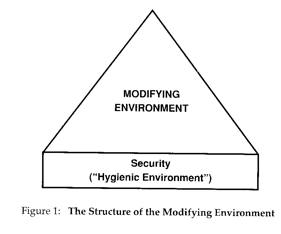
From the perspective of the Modifying Environment, however, the security element can also be viewed as providing a temporary, two-way shield, protecting the student from environmental risks and dangers as well as protecting the environment from undue interference by the student that might rebound against him or her in ways that are beyond his or her capacity to manage. It is viewed as temporary because, while designed to provide protection from what may not be effective in promoting growth at a particular point in a student’s life, it should also be carefully modulated so as to make increasing demands as the student is able to assume increasing responsibility for arrangements to meet his own security needs. In short, it refers to what has been cited above as the hygienic environment (Redl & Wineman, 1957), fine tuned to meet the student’s developmental needs at any given time.
The Modifying Environment as it has been described above, represented by the triangle in Figure 1, is introduced atop this necessary foundation of security. It includes, on a planned basis, such elements as heterogeneity, unfamiliarity and unpredictability, a gap between required tasks and the individual’s current level of functioning, and the stress that results from being confronted with such situations “maintained at levels that are manageable by the student with available help.
The specific goals of the program and the nature and needs of those involved should determine the relative size and content of the “security base" and the “modifying triangle" in a particular setting or for a particular client. It has been suggested that the developmental needs of young people can be reduced to two: roots and wings; these are the two elements described here, in the context of which all programs for young people should be developed and assessed.
The Variables Applied
Although suggestive evidence of the efficacy of. programs
developed in this framework in related domains exists (e.g., Feuerstein,
Krasilowsky, & Rand, 1977), the authors are more convinced by the
conceptual basis of the model that it holds much potential for enhancing
community-based as well as residential services for children and youth.
At this point, the suggested variables provide a basis for direct care
practitioners as well as agency heads and others to begin to assess
their programs as providing what we have called Modifying Environments,
and to relate these to student outcomes. An effort to develop
instruments to facilitate the assessment of Modifying Environments is
currently under way and will be reported later, as will the more
specific programmatic elements of Modifying Environments in a variety of
child and youth service settings.
References
Aichorn, A. (1935). Wayward Youth. New York: Viking Press. Allerhand, M. E., Weber, R., & Haug, M. (1966). Adaptation and adaptability: The Bellefaire follow-up study. New York: Child Welfare League of America.
Arieli, M., Beker, J., & Kashti, Y. (1990). Residential group care as a socializing environment: Toward a broader perspective. In J. Anglin, C. Denholm, R. Ferguson, & A. Pence (Eds.), Perspectives in professional Child and Youth Care (pp. 45-58). New York: Haworth. (Also in Child & Youth Services, 1(1), 45-58.)
Bacon, S. B., & Kimball, R. (1989). The wilderness challenge model. In R. D. Lyman, S. Prentice-Dunn, & S. Gabel (Eds.), Residential and impatient treatment of children and adolescents (pp. 115-144). New York: Plenum.
Barnes, F. H. (in press). From warehouse to greenhouse: Play, work, and the routines of daily living in groups as the core of milieu treatment. In J. Beker & Z. Fisikovits (Eds.), Knowledge utilization in residential Child and Youth Care practice. Washington, DC: Child Welfare League of America.
Beker, J. (1981). New roles for group care centers. In F. Ainsworth & L. C. Fulcher (Eds.), Group care for children: Concept and issues (pp. 128-147). London: Tavistock.
Beker, J.” (1987). To hell and back: Community implications of residential group care experiences in America. In Y. Kashti & M. Arieli (Eds.), Residential settings and the community: Congruence and conflict (pp. 48-64). London: Freund.
Beker, J. (1989a). Editorial: The case of the missing cornerstone. Child and Youth Care Quarterly, 18 (4), 225-226.
Beker, J. (1989b). Editorial: On the nature of modifying environments–A preview. Child and Youth Care Quarterly, 18 (3), 159-160.
Beker, J. (in press). Back to the future: Effective residential group care and treatment for children and youth and the Fritz Redl legacy. Residential Treatment for Children and Youth.
Beker, J., & Durkin, R. P. (1989). The role of work in residential group care programs for children and youth. St. Paul, MN: Center for Youth Development & Research, University of Minnesota.
Beker, J., & Feuerstein, R. (1989). The cognitive development of children and youth and the group care agenda: The case of the missing cornerstone. Jerusalem, Israel: Hadassah-WIZO-Canada Research Institute.
Beker, J., & Feuerstein, R. (1990). Conceptual foundations of the modifying environment in group care and treatment settings for children and youth. Journal of Child and Youth Care, 4(5), 22-33.
Beker, J., & Feuerstein R. (1991). The modifying environment and other environmental perspectives in group care: A conceptual contrast and integration. Residential Treatment for Children and Youth, 8 (3), 21-37.
Bettelheim, B., & Sylvester, E. (1948). A therapeutic milieu. American Journal of Orthopsychiatry, 18,191-206.
Brendtro, L. K. (1985). Making caring fashionable: Philosophy and procedures of service learning. Child Care Quarterly, 14, 4-13.
Brendtro, L. K., & Ness, A. E. (1983). Re-educating troubled youth: Environments for teaching and treatment. New York: Aldine.
Durkin, R. P., & Durkin, A. B. (1975). Evaluating residential treatment programs for disturbed children. In M. Guttentag & E. L. Struening (Eds.), Handbook of evaluation research (Vol. 2, pp. 275-339). Beverly Hills, CA: Sage.
Fisikovits, Z., & Beker, J. (1983). Beyond professionalism: The Child and Youth Care worker as craftsman. Child Care Quarterly, 12, 93-112. (Discussion 113-120).
Feuerstein, R. (1970). A dynamic approach to the causation, prevention, and alleviation of retarded performance. In H. C. Haywood (Ed.), Social-cultural aspects of mental retardation: Proceedings of the Peabody-NIMH Conference (pp. 341-377). New York: Appleton Century-Crofts, 1970.
Feuerstein, R., & Hoffman, M. 8. (1982). Intergenerational conflict of rights: Cultural imposition and self-realization. Viewpoints in Learning and Teaching: The Journal of the School of Education (Indiana University), 58(1), 44-63.
Feuerstein, R., Hoffman, M. B., Rand, Y., Jensen, M. R., Tzuriel, 0., & Hoffman, D. B. (1986). Learning to learn: Mediated learning experiences and instrumental enrichment. Special Services in the Schools, 3 (1/2), 49-82
Feuerstein, R., Krasilowsky, D., & Rand, Y. (1977). Modifiability during adolescence: Theoretical aspects and empirical data. In J. Anthony (Ed.), Yearbook of the International Association for Child Psychiatry and Allied Professions. London.
Goffman, F. (1961). Asylums: Essays on the social situations of mental patients and other inmates. New York: Anchor Doubleday.
Jones, M. (1953). The therapeutic community. New York: Basic Books. Jones, M. (1956). The concept of a therapeutic community. American Journal of Psychiatry, 112, 647-650.
Jones, R. R., Weinrott, M. R., & Howard, J. R. (1981). Impact of the Teaching Family Model on troublesome youth: Findings from the National Evaluation. Rockville, MD: National Institute of Mental Health (NTIS No. PBS2-224353).
Kagan, J., & Klein, R. F. (1973). Cross-cultural perspectives on early development. American Psychologist, 28, 947-961.
Korczak, J. (1967). Selected works of Janusz Korczak. Warsaw. Scientific Publications Foreign Cooperation Center of the Central Institute for Scientific, Technical, and Economic Information.
Lerman, P. (1982). Deinstitutionalization and the welfare state. New Brunswick, NJ: Rutgers University Press.
Levy, Z. (1991). Eagerly awaiting a home: A response from abroad. Child and Youth Care Forum, 20(1), 31-34.
Lewis, W. W. (1982). Ecological factors in successful residential treatment. Behavioral Disorders, 7, 149-156.
Lewis, W. W. (1984). Ecological change: A necessary condition for residential treatment. Child Care Quarterly, 13, 21-29.
Maier, H. W. (1987). Developmental group care of children and youth: Concepts and practice. New York: Haworth. (Also published as Child & Youth Services, 9 (2).)
Makarenko, A. S. (1955). The road to life: An epic of education. Moscow: Foreign Languages Publishing House. (Also Moscow: Progress Publishers, via Imported Publications, Inc., Chicago.)
Maluccio, A. N., Fein, F., & Olmstead, K. A. (1986). Permanency planning for children: Concepts and methods. London: Tavistock.
Montalvo, B., & Pavlin, 5. (1966). Faulty staff communications in a residential treatment center. American Journal of Orthopsychiatry, 36, 706-711.
Nelson, R. H., Singer, M. J., & Johnsen, L. 0. (1978). The application of a residential treatment evaluation model. Child Care Quarterly, 7, 164-173.
Perrow, C. (1963). Reality shock: A new organization confronts the custody/treatment dilemma. Social Problems, 10, 374-382
Perrow, C. (1966). Reality Adjustment: A young institution settles for humane care. Social Problems, 14, 69-79.
Redl, F. (1959). The concept of a “therapeutic milieu." American Journal of Orthopsychiatry, 29, 721 -736.
Redl, F., & Wineman, D. (1957). The aggressive child. New York: Free Press.
Taylor, D. A., & Alpert, S. W. (1973). Continuity and support following residential treatment. New York: Child Welfare League.
Trieschman, A. E. (1969). Understanding the nature of a therapeutic milieu. In A. E. Trieschman, J. K. Whittaker, & L. K. Brendtro, The other 23 hours: Child care work in a therapeutic milieu (pp. 1-50). New York: Aldine.
Tuggener, H. (undated). Social pedagogics as a profession–A historical survey. In H. 0. Jones (Ed.), The social pedagogue in Europe” Living with others as a profession (pp. 8-39). Zurich: FICE International (Federation Internationale des Communautes Educatives).
White, K. 1. (1984). Living as a family. In T. Philpot (Ed.), Group Care Practice: The challenge of the next decade (pp. 132443). Sutton, Surrey, UK: Community Care/Business Press International.
Whittaker, J. K. (1976). Introduction (to Special Report on Innovative Approaches to Community-based Treatment for Children and Adolescents). Child Care Quarterly, 5, 85-91.
Whittaker, J. K., Overstreet, E. J., Grasso, A., Tripodi, T., & Boylan, F. (1988). Multiple indicators of success in residential youth care and treatment. American Journal of Orthopsychiatry, 58, 143-147.
Whittaker, J. K., & Pecora, P. (1984). A research agenda for residential care. In T. Philpot (Ed.), Group care practice: The challenge of the next decade (pp. 71-87). Sutton, Surrey, UK: Community Care/Business Press International.
Wolfensberger, W. (1972). The principle of normalization in human services. Toronto: National Institute of Mental Retardation.
Wolins, M. (1974). Group care: Friend or foe? In M. Wolins (Ed.), Successful group care: Explorations in the powerful environment (pp. 267-290). Chicago: Aldine. (Also in Social Work, 1969, 14, (1), 37-53.)
Wolins, M., & Gottesman, M. (1971). Group care: An Israeli approach. New York: Gordon and Breach.
This feature: Beker, J., & Feuerstein, R. (1991) Toward a Common Denominator in Effective Group Care Programming: The Concept of the modifying environment. Journal of Child and Youth Care Work, Vol. 7 pp.20-34


